





































Every story beat, read aloud.
97%of the voice in Latitude's Voyage, on Inworld
up to 5×faster than the closest alternative














Realtime voice AI for consumer-facing applications, with first audio in as little as 50 ms.
Ask your agent to add Inworld.
Voices that take direction, at the speed of conversation. Realtime TTS-2 speaks about 500 languages; Realtime TTS-2 Flash answers in 50 ms.
Cloned and designed voices bill at the same rate as stock voices, while Google lists its instant custom voices at $60 per million characters.
Direction laughing with delight and disbelief barely able to get the words out
I can't believe you did that.
{
  "text": "[laugh] I can't believe you did that.",
  "voiceId": "Hana",
  "modelId": "inworld-tts-2",
  "instruction": "laughing with delight and disbelief barely able to get the words out",
  "deliveryMode": "BALANCED"
}Described as“A warm, gravelly older man with a slow, easy pace and a smile in his voice.”
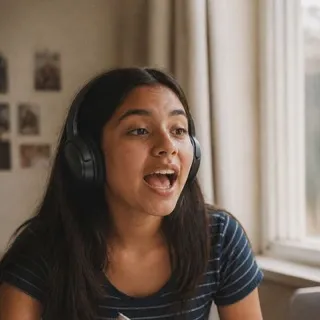
Described as“A bright, fast-talking teenage girl from California, excited and a little breathless.”
Described as“A calm, low-voiced British woman reading the late-night shipping forecast on the radio.”
おはよう。コーヒーができたよ。今日はいい天気だね。




Running coach
Get word and character timings for captions, and visemes for lip-sync that add no latency.
Write a word in IPA inline so names and brands sound right.
Point the OpenAI SDK at api.inworld.ai/v1 and pick an Inworld voice, and the rest of your code stays the same.
Send up to 100,000 characters as one async job, and batch jobs bill 20% less per character. Both are in preview.
Run inworld tts synthesize from the shell, or let your coding agent call text to speech through the MCP server.
Turn it on for your organization or a single workspace, and we never store your requests or audio.
Speech Reasoning decides how each line should sound. It reads the conversation and directs the delivery for you, no tags needed.
“Wait, you drove all the way here in the snow just to bring me soup? You're ridiculous. Come in, come in, you must be freezing.”
Speech Reasoning runs in the TTS playground while it is in beta, and the playground shows the direction it wrote next to the audio.
Hear it in the playground ↗
Talking to an assistant


import base64, json, os, requests

r = requests.post(
    "https://api.inworld.ai/tts/v1/voice:stream",
    headers={"Authorization": f"Basic {os.environ['INWORLD_API_KEY']}"},
    json={
        "text": "Your table for four is booked for eight tonight.",
        "voiceId": "Sarah",
        "modelId": "inworld-tts-2",
        "audioConfig": {"audioEncoding": "MP3"},
    },
    stream=True,
)
r.raise_for_status()
with open("table.mp3", "wb") as f:
    for line in r.iter_lines():  # NDJSON: one JSON object per line
        if line:
            msg = json.loads(line)
            if "error" in msg:
                raise RuntimeError(msg["error"])
f.write(base64.b64decode(msg["result"].get("audioContent", "")))This streams Realtime TTS-2. Each line of the response is one JSON object with base64 audio, and the script wrote table.mp3.
Text to speech built for people runs on Inworld. Who are you building for?
To add Inworld AI's text to speech to an app, create an API key in the Inworld Portal and send your text, a voice ID and a model ID to the TTS API in a single POST. You can test voices and clone your own in the TTS Playground first. Output formats include MP3, WAV (linear PCM) and Opus. If your app already uses OpenAI's text to speech, point the OpenAI SDK at api.inworld.ai/v1 and choose an Inworld model and voice.
Realtime TTS, Inworld AI's text to speech, starts from $7 per million characters, for Realtime TTS-2 Flash on the Growth plan. On demand, Realtime TTS-2 is $25 and falls to $15 at $300 per month and $12.50 at $1,500 per month, and Realtime TTS-2 Flash is $15 and falls to $7. On Enterprise, Realtime TTS-2 goes down to $10 and Realtime TTS-2 Flash down to $5. Voice cloning itself is free, so you pay only for synthesis, and the rate falls further as your total spend grows.
For most applications, use Realtime TTS-2, the flagship of Inworld AI's text to speech models. It has the most expressive output and natural-language steering, so start here unless you have a specific latency or cost constraint. Choose Realtime TTS-2 Flash when minimal latency or cost is your top priority, for example voice agents that need the fastest first audio, or high-volume workloads where cost per character decides.
On Coval's independent latency board, Inworld AI's Realtime TTS-2 Flash is among the fastest text to speech models, with first audio as low as 50 ms, up to 3× sooner than ElevenLabs Flash v2.5. Realtime TTS-2 returns its first audio byte in as little as 90 ms at P90. Both models stream over WebSocket and HTTP.
Yes, Inworld AI's text to speech includes instant voice cloning, which creates a custom voice from as little as 3 seconds of audio, up to 30 seconds. Every user can run it in the playground or through the API. Professional voice cloning, in beta on Realtime TTS-2, fine-tunes on a larger set of recordings and suits uncommon voices such as children's voices or unique accents, where instant cloning may not perform well. Either way you get a voiceId to use in the playground or the API.
Inworld AI's Realtime TTS-2 text to speech model speaks about 500 languages and dialects, through 623 language and locale codes, and it can switch language inside a single sentence. Cross-lingual synthesis lets you reuse one voice across languages, so a multilingual product does not need a separate voice per market. Realtime TTS-2 Flash, the faster model, covers fewer languages.
Yes, on Inworld AI's Realtime TTS-2 text to speech you describe the delivery in plain words, such as "whispering, shocked, so nobody else hears", and send it as the request's instruction. For a delivery that changes partway through a line, write the new direction in brackets at that point; it holds until you change it or write [reset]. Both models render 50 non-verbal sounds such as [laugh] and [sigh], and you can set the speaking rate from 0.5× to 1.5×.
Yes, a free ElevenLabs Migration Tool, published on GitHub, moves your custom voice clones from ElevenLabs to Inworld AI's text to speech in a batch. It downloads your ElevenLabs voice samples, handles the audio processing (format conversion, padding and trimming) and re-clones them in Inworld. The migration runs entirely on your local machine with direct API calls, so no data passes through an intermediary server. On Enterprise, Realtime TTS-2 Flash costs up to 16× less than the $80 per million characters Eleven v4, ElevenLabs' newest model, lists.